Showing posts with label ramblings. Show all posts

Friday, October 1, 2010

Caffeine Deficiency

My wife has been complaining that she always feels nauseous after taking her daily vitamin. On the theory that it was perhaps a result of taking them first thing in the morning on an empty stomach, she tried taking them at night with dinner. I saw with my own eyes what she was talking about: she almost vomited.

So, I told her to start taking mine instead and I'd finish her vitamins off. Well, I'm not doing that again. I don't know what it is about One A Day Women's Active Metabolism vitamins, but they made me sick too. While we hate wasting the money, we just chucked the rest of the bottle because there was no way either of us were ever taking those again. Before we tossed the bottle in the trash, though, we were examining the label for differences between her One A Day Women's Active Metabolism and my One A Day Men's vitamins that might account for the nausea. In particular, we were looking for ingredients that were in higher concentration in the women's vitamins.

There are a few: vitamins D, K, B1, B2, B6, Calcium, and Iron to be exact. But I couldn't find any hard evidence that any of these vitamins could cause the sort of nausea we experienced (at least not in quantities we are likely to be exposed to). But that is when we noticed what makes the women's vitamins earn the "active metabolism" moniker:


Caffeine, and lots of it. Guarana seed is just another source of caffeine, so it is possible that its 50mg is included in the total of 120mg of caffeine in each "vitamin" pill. But if not, that means that 1 One A Day Women's Active Metabolism pill has more caffeine (~170mg) than a cup of coffee (100-150mg) and approaching that of a single Vivarin pill (200mg).

While neither of us drinks much coffee and we try to avoid caffeinated drinks, I doubt that 170mg of coffee in the morning would be enough to induce nausea. After all, millions of people have a cup of coffee in the morning and that is approximately the same amount of caffeine.

But, we never expected to have caffeine added to vitamin pills. I guess that is what we get for not having looked at the label before buying them. We certainly won't be making that mistake again.

All that background out of the way, this experience got me thinking: just how much caffeine do people consume everyday now? Here my wife was getting a base 170mg a day without even knowing it. The marketing for caffeinated products tends to emphasize that it helps you stay "mentally aware"; how long before being constantly-caffeinated is considered the norm and the symptoms of caffeine deficiency are "mentally sluggish"?

At what point does caffeine go from "booster" to baseline? Is there a point in our future wherein caffeine belongs in vitamins and even has a FDA-recommended daily allowance?

Thursday, January 7, 2010

The Public Option

Every time I have to take off my shoes at the airport, I'm grateful that Richard Reid stuck explosives in his shoes rather than his ass. Waiting in line while people take off their loafers and flip-flops is silly, but waiting in line while people get full cavity searches might make me think twice about flying.

Anyway, as everyone has surely heard by now, an idiot on a flight to Detroit lit his nuts on fire for Christmas. So now the TSA will be installing new full-body scanners to see if we have anything stuffed in our trousers. I haven't heard the details, but I suppose you are privy to a more intimate inspection if something in your pants draws attention.

And then today I received an e-mail from my friend Matt alerting me that, sure enough, suicide bombers are now stuffing explosives in their rectums. Unless these new airport scanners can see clear into my bowels and distinguish between a Taco Bell lunch and IED, I wonder how far off we are from getting free colon exams whenever we fly.

Actually, I think I may have stumbled upon health care reform that everyone can get behind. The TSA can be our delivery method for socialized health care. If the TSA is going to be probing every orifice looking for explosives anyway, with a modicum of medical training, they could alert us to any potential medical conditions we might not have been aware of while they are in there. Everybody wins: planes are safer, people are healthier, and we save money on colon exams, prostate checks, and gynecologist visits.

It might cost a little money to implement, but who would object? Only terrorists could be against making our skies safer.

Monday, November 9, 2009

Government isn't all bad

The big news today is that the U.S. House of Representatives passed a health care reform bill. I'm not particularly impressed with the details of the bill passed nor am I particularly concerned with them...they will most certainly change when reconciling differences with whatever the Senate passes (assuming they pass something).

But, I'll use this is setup to post a link to an interesting counter to nay-sayers scared of government intervention in the health insurance industry.

Update 2009/12/15:
It seems the blog I linked to is no more so I'll go ahead and post the entirety of the message here...

This morning I was awoken by my alarm clock powered by electricity generated by the public power monopoly regulated by the U.S. Department of Energy.

I then took a shower in the clean water provided by a municipal water utility.

After that, I turned on the TV to one of the FCC-regulated channels to see what the National Weather Service of the National Oceanographic and Atmospheric Administration determined the weather was going to be like, using satellites designed, built, and launched by the National Aeronautics and Space Administration.

I watched this while eating my breakfast of U.S. Department of Agriculture-inspected food and taking the drugs which have been determined as safe by the U.S. Food and Drug Administration.

At the appropriate time, as regulated by the U.S. Congress and kept accurate by the National Institute of Standards and Technology and the U.S. Naval Observatory, I get into my National Highway Traffic Safety Administration-approved automobile and set out to work on the roads build by the local, state, and federal Departments of Transportation, possibly stopping to purchase additional fuel of a quality level determined by the Environmental Protection Agency, using legal tender issued by the Federal Reserve Bank.

On the way out the door I deposit any mail I have to be sent out via the U.S. Postal Service and drop the kids off at the public school.

After spending another day not being maimed or killed at work thanks to the workplace regulations imposed by the Department of Labor and the Occupational Safety and Health administration, enjoying another two meals which again do not kill me because of the USDA, I drive my NHTSA car back home on the DOT roads, to my house which has not burned down in my absence because of the state and local building codes and Fire Marshal's inspection, and which has not been plundered of all its valuables thanks to the local police department.

And then I log on to the internet -- which was developed by the Defense Advanced Research Projects Administration -- and post on Freerepublic.com and Fox News forums about how SOCIALISM in medicine is BAD because the government can't do anything right.

Tuesday, July 28, 2009

Politics as Usual

Everyone has their own perspective on the world and their own circumstances influencing their beliefs. What seems right and just to me can seem horrible and unfair to someone else. The founding fathers of the United States of America recognized this truth; in Federalist #10, James Madison wrote that the various competing regional, religious, and economic interests, factions, and parties would be the guarantor of American freedom and justice.

Everyone in America is entitled to their own opinion, representing their own interests. People can try to drum up support for their own ideas by sharing them with others and these ideas compete for mind share with the ideas of others among the American populace.

This is how politics in America works; it is like capitalism applied to the ephemeral world of ideas. And just like capitalism in the market, it should not be surprising that purveyors of ideas often have their own profit motives.

I suppose that statement is somewhat redundant because I believe, to most, the word "politics" is assumed to be the marketing of ideas with underlying profit motives. In which case, to be American is to be constantly embroiled in politics -- to be constantly inundated with ideas, sometimes of dubious motive.

Which is why it is imperative that we each form our own ideas, reflecting our own self-interests. I would dare say that each and every American has their own circumstances, their own obstacles, their own concerns, as well as their own hopes and dreams. And sometimes people's interests conflict.

So ask yourself: if you could change America in a way that would make your life better, what would you do? If you could improve absolutely anything, what would you do? How would you convince others to help you out? If people don't support your idea, what would you do?

Now ask yourself: what are others doing to try to influence you?

Sunday, June 28, 2009

Not-so-Cool Biz

It is still the rainy season here in Japan but the temperature is slowly creeping up as we head towards summer. Today's high is forecast to be 30 degrees (86 degrees Fahrenheit).

Which wouldn't be too much different than the weather this time of year in my home town in Virginia except for two things:
  1. In Virginia we commute by car and cars have air-conditioning; in Japan most people commute by walking or riding a bike to the train station and taking a crowded train.
  2. Cool Biz
Today I'm going to focus on #2. If you aren't familiar with "Cool Biz", there is a nice article over on Slate about this Japanese campaign to reign in energy usage by making everyone uncomfortable.

The gist of Cool Biz is to crank up the temperature in offices to a balmy 28 degrees Celcius (82.4 degrees Fahrenheit) and allow people to "dress down" to compensate. By "dress down", we're talking not having to wear a tie.

I've heard the figure 4 degrees bantered around as the difference not wearing a tie can make. But when I tried researching where that number came from, I cannot find any research measuring the relative apparent temperature with and without a tie. The number (which I presume is in degrees Celsius) seems to appear only in articles about Cool Biz and only as a number the Japanese government cites.

Not surprisingly, the large company I'm working at here in Tokyo is following the government's recommendation and has the thermostats set for 28 degrees. And I can tell you first-hand that the heat is incapacitating.

I was doing some research on how to deal with the heat and ran across some tips for living without air conditioning. For a wussy American such as myself who has been spoiled by comfortable working conditions for my whole life, 82.4 degrees might as well be no air conditioning. The tips:
  • Turn on fans to keep the air circulating.
We have 2 fans in a room with over 100 people in it.
  • Set ceiling fans to turn clockwise (counter-clockwise looking toward it).
Not really applicable in an office environment.
  • Keep curtains or blinds closed during the day.
Blinds are kept open all day.
  • Use light colored curtains to deflect heat.
The blinds are white. So if we were allowed to close them, it might help.
  • Keep windows and doors closed tightly to keep the house cool.
Check.
  • If there is a breeze or if outside air feels cooler than inside, open the window bringing in the cooler.
  • Keep sunny windows closed if there is no breeze.
  • In late afternoon, as soon as outside temperatures feel lower than inside temperatures, open all windows and doors.
  • In the evening, when it’s cool outdoors but still hot indoors, place fans in front of open windows to draw in the cool air.
I work in a fairly old office building that still has windows you can actually open. However, we are forbidden from opening them. Rumor has it that a couple years back someone snapped and try to jump out a window. Since then, we've been strictly forbidden from opening the windows. I suspect it was the heat that drove him to it.
  • Keep as many windows as possible open during night to take advantage of the cool night air to lower inside temperatures.
  • In the morning, close windows as soon as the outside air begins feeling warmer than inside air.
Besides not being feasible in an office environment, see the notes regarding the previous tips.
  • Limit strenuous physical activity until evening.
Check.
  • Drink lots of cold water.
And check.
  • When hot, use a water spritzer to spray yourself. The evaporating water will make you feel cool. (For fun, you can also spritz the water upwards and feel it fall down on you. The coldness can be quite shocking.)
I work in an open office floor plan with people sitting 2 feet from me in each direction and no walls. This might work if they are amicable to the idea too.
  • Tie a wet bandanna around your neck (this is something I do for my dog to prevent overheating and heatstroke during the summer).
I think we have a winner. I think I may have to try this one when the summer heat really sets in. Maybe I can start a fashion trend of white buttoned-up dress shirt, dress slacks, and a wet bandana. If I combining it with spritzing water, I can call it "wet biz".

Monday, June 8, 2009

Whats and Whys

I just realized something about myself today: when someone is talking to me, I'm not only listening to what they are saying, but also trying to deduce why they are saying it. Not consciously, of course, or else I would have realized that I'm doing it long before now. :)

In hindsight, I think this has been mostly a good thing. As a software engineer, when a request comes in for feature "X", rather than just understanding that the customer wants feature "X" and immediately starting to work on solving that problem, somewhere in the back of my brain I'm thinking about why the user asked or "X". What are they probably trying to accomplish? Is there perhaps a simpler way to achieve the same result that we can present as a counter-proposal? Is this something other customers might need too? If they are asking for feature "X" now, then they'll probably need feature "Y" at some point in the future too.

Which is to say that I think this has made me a better software engineer. However, sometimes it takes me a night or two of "sleeping on it" before I start being aware of the implications of the request. I've gotten into the habit of splitting my project to-do list into "things needed to do what the customer specifically asked for" and "things needed to do what the customer probably wants" categories. Obviously, the items in the list needed to satisfy the customer's explicit requirements always take priority. But I'll freely add items to the "customer will probably want" list as they occur to me, to be implemented in down time between projects or assigned as introductory tasks to junior engineers to get them familiar with the code base. From experience, I've found that this process results in more generic solutions to problems that make the product more resilient to changing requirements and adaptable to new customers.

On the flip side, I've gotten myself in trouble a few times by reading to much into my wife's words. I don't think I'm unique in that regards either. :)

Today I realized that I am sometimes perplexed by requests/statements from my Japanese co-workers. Of course there is the language barrier which means that it takes a lot more effort on my part to understand what is being said. But sometimes I know I comprehend what they are saying, but I still have an uneasy, discontent feeling. That is when I realized that my brain is subconsciously trying discern the "why" behind the statement and failing, causing the uncomfortable feeling.

As for why it is failing, I'm still unsure. But now that I think I know what is going on, I can work to address it. I suspect it may have nothing to do with the fact that the statements are in Japanese, but rather be a symptom of information asymmetry inherent in working in a large company. In which case, it would explain why I always seem to flourish in small company environments where information is more evenly distributed, hence making it easier to deduce the "why" behind new tasks.

Sunday, February 15, 2009

Procreation Propaganda

The current fashion in Japan is babies.

For the past 2 or 3 years, there has been a concerted effort on the part of the Japanese government to fight Japan's shrinking population by encouraging more women to have kids. At first, they tried the obligation and duty angle: news was that the Japanese people needed to produce more children to maintain Japan's status as the second wealthiest country in the world. Then, the government started providing more services to ease child rearing; some of these were long overdue, such as maternity care programs and day-care centers for working parents.

Let be reiterate that because the concept may be unbelievable to readers from modern nations: until just recently, day-care centers were few and far between in Japan; what few there are were very expensive and, until deregulation in 2000, run by the government. The concept of a babysitter is still foreign here. Of course, things are changing, but Japan has gotten an awfully late start.

I wish I had taken a picture of it, but I recall a poster on the train a few months back that sent the clear, if not implicit, message that if you have kids then people will be nice to you. In a country in which people rarely acknowledge your existence, that's a pretty bold statement. We're going to skip the courteous stage and jump right from the treating-you-as-an-obstacle stage to the being-kind-to-you stage...all you need is a kid.

There has been much internal discourse in Japan about the ramifications of a shrinking population. By and the large, the message is "have more children" because "shrinking is bad". I have not read the multitude of books on the subject, but the message sent by the in-train posters, celebrity magazines, and "talent"-riddled Japanese television shows is "kids are cool".

Don't get me wrong: kids are cool. What is uncomfortable to me is the idea of the government intervening in my personal life to support an official policy to counter the shrinking population.*

The pretext to all this commotion is that a shrinking population is bad. However, Professor Akiko Matsutani disagrees and in 2007 wrote a book titled "Shrinking Population Economics" in which he claims the shrinking isn't bad, but rather provides an opportunity for Japan to improve the quality of life for its smaller population. In his book, he argues that Japan should not focus on producing a new army of alcohol-numbed workaholics, but rather let workers enjoy more time with their family, take up hobbies, and unwind on holidays.

Which actually brings the argument around full circle. Perhaps the 12-hour+ work days, 3+ hour commutes, semi-regimented drinking parties, etc. with little or no time left to spend at home are as much to blame for the current "baby crisis" as anything. You can't be a family if you are never home. If the only time you see your spouse is for a few minutes as your drag your groggy butt back home after a long day at the office, is it really any surprise you don't have more kids.

The government solution: use propaganda to encourage people produce another generation of workaholics with no time or energy to have children themselves. Professor Matsutani's solution: make life enjoyable, kids or not. Life is to be enjoyed, not frittered away in some Orwellian dystopia. And the irony is, happier couples are more likely to have children.


* I use the phrase "my personal life" empathetically with the Japanese people. As a foreigner in Japan, the government couldn't care less whether I have kids or not.

~~~

As a timely addendum to my ramblings:
Canon has taken the initiative to send its workers home at 5:30pm (only twice a week, mind you). But it sends them home with homework: to make babies.
I wonder if they get performance reviews.

Thursday, January 22, 2009

It's the End of the World as We Know It

And I Feel Fine.

Living in Japan for the past year, I largely missed out on the 24-hour coverage of the presidential election. In fact, even though I registered to vote absentee, I never did get my ballot. In any event, I never got that caught up in the presidential election. To be honest, though, while I was impressed with Obama's message of optimism after 8 years of fear, I didn't have a whole lot of faith he would follow through with his promise of change.

So while I was happy the Obama won the election, more for what it said about my fellow Americans than what it said about Obama, I was hesitant to believe in "change" until I saw it. In particular, I wanted to see Obama make his first act as president be to close the Guantanamo Bay prison. That, more than anything to me, would signal the Obama is serious about restoring American ideals.

Well, it wasn't his first act, but my eyes teared up this morning when I read the news: Obama orders Gitmo to close. 3 days into his presidency and he's committed to shutting down that black-eye of injustice and putting America back on the high road of morality.

In the words of the 2nd century philosopher Hierocles,
We ought always to deal justly, not only with those who are just to us, but likewise to those who endeavor to injure us; and this, for fear lest by rendering them evil for evil, we should fall into the same vice.
As an American, today is truly a proud day.

Monday, January 19, 2009

Open Plan Offices

The office that I work at, like many other offices in Japan, is what they call an "open plan office". If you search google images for "open plan office", you'll see page after page of images of hip-looking, airy spaces with lots of natural lighting and no walls. Japanese open plan offices are similar, but without the hipness, airy spaces, or natural lighting. Just long tables full of people sitting at computers under row-after-row of fluorescent lighting. My office consists of over 100 people sitting in 1 giant room. Cozy might be a good word to describe it.

And let me tell you, when the air conditioners shut down at 6pm, it gets mighty toasty -- even in the dead of winter.

I searched google images for some representative samples of Japanese open plan offices. You don't have to look hard, a simple search for "オフィス" ("office" in Japanese) yields almost nothing but open plan office pictures. Oddly, the pictures have tiny 1-foot tall dividers separating facing people for some semblance of personal space; I don't have that luxury at my office.

Anyway, having worked in this environment for over a year now, I took special interest in a recent study from Australia's Queensland University of Technology. In that study, they found that:

In 90 per cent of the research, the outcome of working in an open-plan office was seen as negative, with open-plan offices causing high levels of stress, conflict, high blood pressure, and a high staff turnover.

...

The high level of noise causes employees to lose concentration, leading to low productivity, there are privacy issues because everyone can see what you are doing on the computer or hear what you are saying on the phone, and there is a feeling of insecurity.

Now that is something I can relate to. I have found it impossible to concentrate on anything in this environment and my productivity has plummeted compared to the comfortable offices (or even cubes) I was used to in the U.S.

I can only hope that the real research and development institutions in Japan have the good sense to give their staff decent working conditions. Otherwise, I cannot fathom how Japan can hope to compete in knowledge industries.

Thursday, December 25, 2008

Merry Christmas

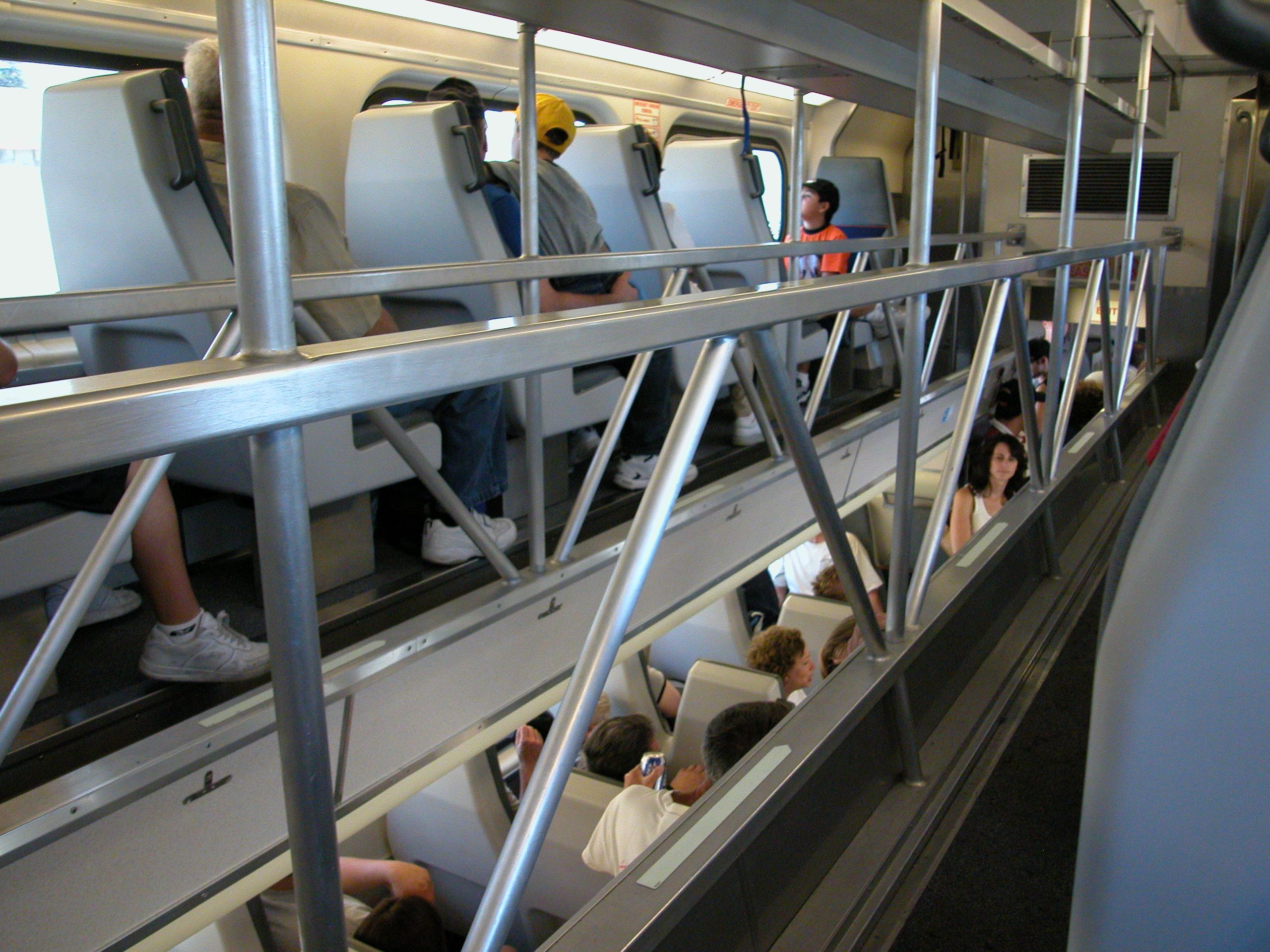
While there are tons of decorations in Tokyo, Christmas isn't actually a holiday in Japan. As such, I had to work on Christmas. While I wasn't able to spend Christmas with my real family, I did spend some quality time with the people who, over the course of the past year, I've come to be pretty close to.

Yep, I'm hijacking a light-hearted Christmas post to talk about trains in Tokyo.

I didn't actually take this picture, but it is pretty representative of how I spend 2 and half hours of my day, five days a week (Christmas included). Occasionally, especially in the evenings, it is so crowded I can't move or, worse, can't even stand over my own center-of-balance (meaning I'm just propped up by the surrounding crowd).

While I'm getting used to it, this was quite the contrast to the comfort of CalTrain, where I could almost always get a seat even when it was crowded. I've always been a big proponent of mass transit, but I now have I new appreciation for the comfort of one's own car. Even if you are stuck in traffic, at least you still have some personal space to call your own.

Sunday, November 16, 2008

A Calculus Lesson

I don't know what triggered it, but this morning I recalled a lesson I learned in high school Calculus class. You see, I was in one of those "advanced" AP Calculus classes, one that was supposed to prepare you for the Calculus AB AP Exam (i.e. the hard one). I don't know if that means anything more these days, but at the time, it was the class all the good students took.

But here is the rub: I was a terrible student. Seriously. This was senior year; while my classmates were keeping tabs on their class ranking to see who was in which position for the top 10, I just kind of floated along and daydreamed about computer programming. I think I had something of a C average in that class; I wasn't even in the top 25% of by graduating class, much less worried about being in the top 10.

Anyway, I never really bought the whole school competition thing. Don't get me wrong: I like learning stuff, but grades were always an afterthought.

The particular incident I remembered this morning, however, was a "challenge" assignment in my Advanced Calculus class. The teacher gave us an assortment of problems that he claimed he also used in his college classes. These problems were supposed to be difficult. We had a week or two to work on them, at the end of which we would turn them in and go over them. I don't recall whether they were to be graded or not, but I latched onto the challenge.

I think there were about 12 or so problems, a few of which weren't anything particularly challenging and everyone got those figured out pretty quick. A few more took a couple of days of trying to arrive at a solution. But the last few I recall being really hard. Each day, before class, my classmates would compare solutions to see if we all arrived at the same answers (we had no answer key).

To tell the truth, I rarely participated in these exchanges. The problem was that some students figured out they could be remoras to the ambitious students' sharks. While a few students compared their solutions and competed to be the first to solve each problem, others would take notes and write the solutions on their own papers.

Now, to me this seemed like cheating at the time. I thought the "smart kids" were getting taken advantage of. I suspect they knew others were copying their answers; maybe they liked the attention, I don't know. Nonetheless, I didn't want to be part of it. I tried solving each problem the best I could. If I was wrong, no big deal...I'd learn the proper solution when the challenge was over. The grade didn't matter, it was the challenge that was exciting. And I didn't want the accomplishment of solving a problem to be sullied by the doubt of having copied it from one of the good students.

Anyway, so things went for most of the assignment. It got down to just one problem that I didn't have a solution for. Again, I don't remember the details, but it had something to do with finding the area of a sphere inscribed in a cone inscribed in a cylinder with the dimensions of the cylinder given in some form. It turns out, that I was not the only one stuck on this problem. No one in my class had solved it.

Well I'll be darned if one morning the solution didn't come to me while I was in the shower. I think we only had a day or two left on the challenge assignment and I was thrilled that I might actually be able to solve all the problems. I think it was in Spanish class that I frantically jotted down my solution and solved to arrive at an answer. I used my intermediate results for the dimensions of the outer cylinder and the inscribed cone to calculate their respective volumes and confirmed that the volume I calculated for the inner sphere was less than the cone it was inscribed in and that the volume of the cone was less than the cylinder. In other words, if nothing else I knew my answer at least made sense.

So I kept my mouth shut in Calculus class that day. If anyone else had managed to solve it, they were apparently doing the same. I started getting excited at the thought that me, the lowest-ranked student in my class, may have actually done something no one there could do.

But the excitement didn't last. You see, the last day before the deadline I blabbed. No one had figured it out, the star students were getting frantic. And someone came over to my desk and asked me if I had figured it out. I hesitated for a second. With only one day left, the odds were I was going to be the only person to solve this particular problem.

And that is when it occurred to me: life isn't a contest. I could keep my solution to myself and be #1 for a day (which is saying something since I graduated 112th out of a class of 420 or so) or I could share the wealth so-to-speak. I didn't show them my answer, though. I spent the 10 minutes or so we had before class to explain how to solve the problem: what things you needed to calculate and how to obtain the parameters needed to calculate them. With that, I knew they could solve it and could still have a clear conscious knowing I didn't just give someone the answer.

Sure enough, by the end of class they had a solution and came back over to compare their answer with mine. Sure enough, they matched. They were happy to have it solved; I felt good having helped someone.

I won't say it wasn't a little disappointing to see them them immediately go back and share the answer with all of the other star students. I suspect almost everyone in the class ended up the answer for that very difficult problem. I'd be surprised if most of them were aware that I had solved it for them, but that was actually kind of fun in and of itself. More importantly, I knew at least one person solved the problem themselves, though, and I knew that they did it based on what I had told them. That felt really good.

Fast-forward 10 years and I found myself working at a Bay Area startup called Backplane with a bright guy named Matt Dillon. Not the actor, the software engineer. I remember a story that the CFO related to me about Matt's previous company, an Internet Service Provider named Best Internet. According to the story, Matt had found Best Internet with a few others and was largely responsible for the technical infrastructure. The servers and whatnot were all hosted in a data center and apparently Matt would, without hesitation, explain the details of how everything worked to any passerby who took an interest. This CFO, who was a childhood friend of Matt's, warned Matt that he shouldn't be giving away company secrets like that.

To which, Matt responded: if they know enough to understand what it is I'm telling them, then they already know enough to build it themselves anyway.

I think that is more-or-less the same thing I realized in my Calculus class so many years before, but he actually put it into words that have stuck with me ever since.

The insight, I think, is not that all information should be free, but rather that there are some truths that there is no benefit in hiding. While some processes, facts, or figures may hold special strategic value, an environment in which all information, no matter what its worth, is horded can be stifling to innovation.

In other words, you can assign a value to all information and a threshold on what you are comfortable sharing. The best engineers I have ever met tend to have pretty low information-sharing thresholds while management tends to err on the high side. The motivations are obvious. Matt, for example, is clearly an engineer while Backplane's CFO was coming from a management perspective.

What I discovered for myself, many moons ago in Calculus class, is that valuing information is a challenging thing. In my case, the information I possessed -- the solution to that problem -- was of questionable value to begin with (I didn't even know whether it was right) and the information would have zero value the following day. Furthermore, my threshold for sharing that information was unjustifiably high -- I didn't stand to gain or lose much if anything by sharing it. To make an unbiased assessment, the only obstacle I had to overcome was my own ego.

And that is the only thing I remember to this day about my high school Calculus class.